New OctoInform explains what a Lean formalization states. Explore OctoInform
New OctoInform explains what a Lean formalization states.
We informalized the Lean proof of the Riemann hypothesis and mapped out its structure: 1.1 million declarations and the 14.9 million dependencies between them.
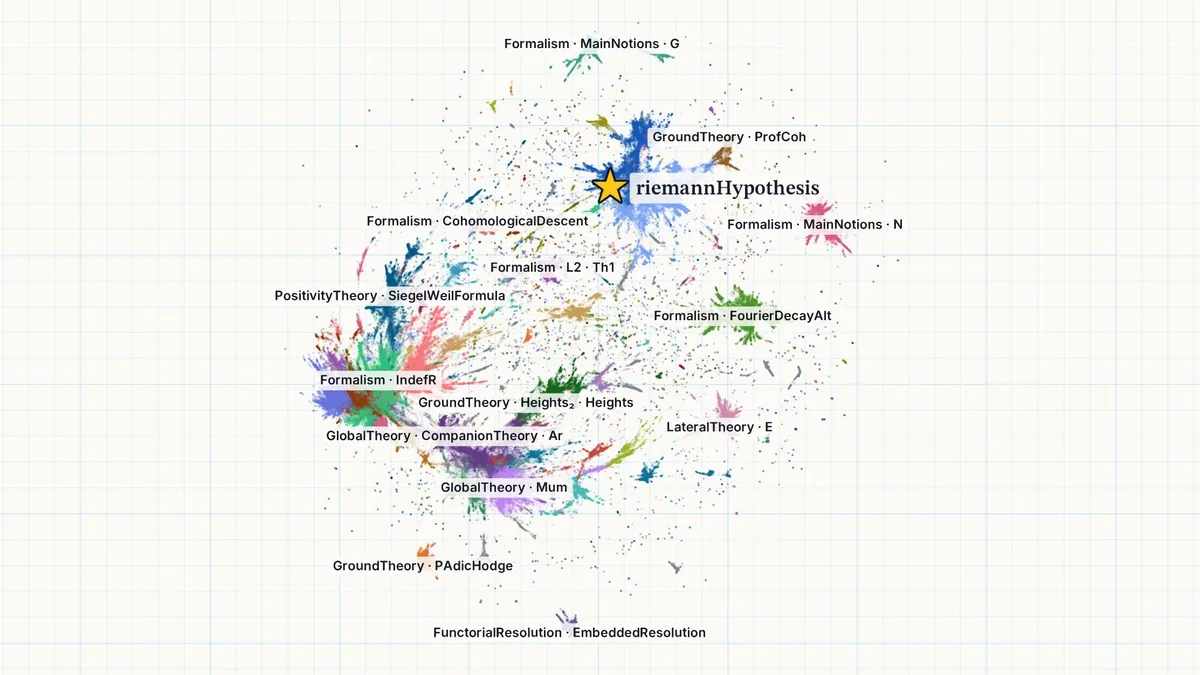
When Levent Alpöge published the proof of the Riemann hypothesis on 20 November 2026, the mathematics community experienced yet another shock, just 10 weeks after the resolution of the Navier–Stokes existence and smoothness problem was announced. Both proofs were formalized in Lean, which reduces the review burden to just the part of the code that states the theorems, leaving the verification of their proof steps to mechanical checks by the Lean kernel. What would’ve taken a team of elite mathematicians months to years to review and validate can now be done on a powerful computer in a matter of hours.
What mathematicians really need, however, is not merely to know whether the hypothesis is true, but to understand the reasoning, insight, and innovation that lies in the proof. Tucking the proof away as esoteric computer code provides no such satisfaction. At Axiomatic, we realised early on that verification through formalization is only a part of the story. We must close the loop and give scientists and mathematicians the tools to properly interpret the torrent of AI-generated and formally verified results.
The first tool is OctoInform, which informalizes any given statements within a Lean library into natural language. The tool is designed to explain the precise meaning of the statements, so that a scientist or mathematician can inspect the formalization without having to traverse dozens of Lean files or even understand the arcane syntax of Lean and Mathlib. Earlier this month, we released an informalization of Axiomatic’s quantum mechanics library, AxQM, as well as a subset of the 722 mathematical manuscripts published by OpenAI. Today, we’re releasing an informalization of key statements in Alpöge’s Lean proof of the Riemann hypothesis.
The second tool is Quiver, which indexes the formal structure of any Lean library as a graph. As a sneak peek, we produced an interactive map of the proof of the Riemann hypothesis from the 14.9 million dependencies between 1.1 million declarations. You can see how the proof relies on distinct clusters of mathematical concepts, and how layers of mathematics are built up to reach the grand theorem.
From the dependency graph alone, we found that:
sp_comp) appears 239 timesYou may also analyze the dependency graph yourself by downloading it from Hugging Face.
While the proof has been machine-checked to be sound, the Lean library itself is clearly a hastily produced artifact. We believe that OctoInform and Quiver are the kinds of tools that will help us go from impenetrable AI proofs to mathematical elegance.